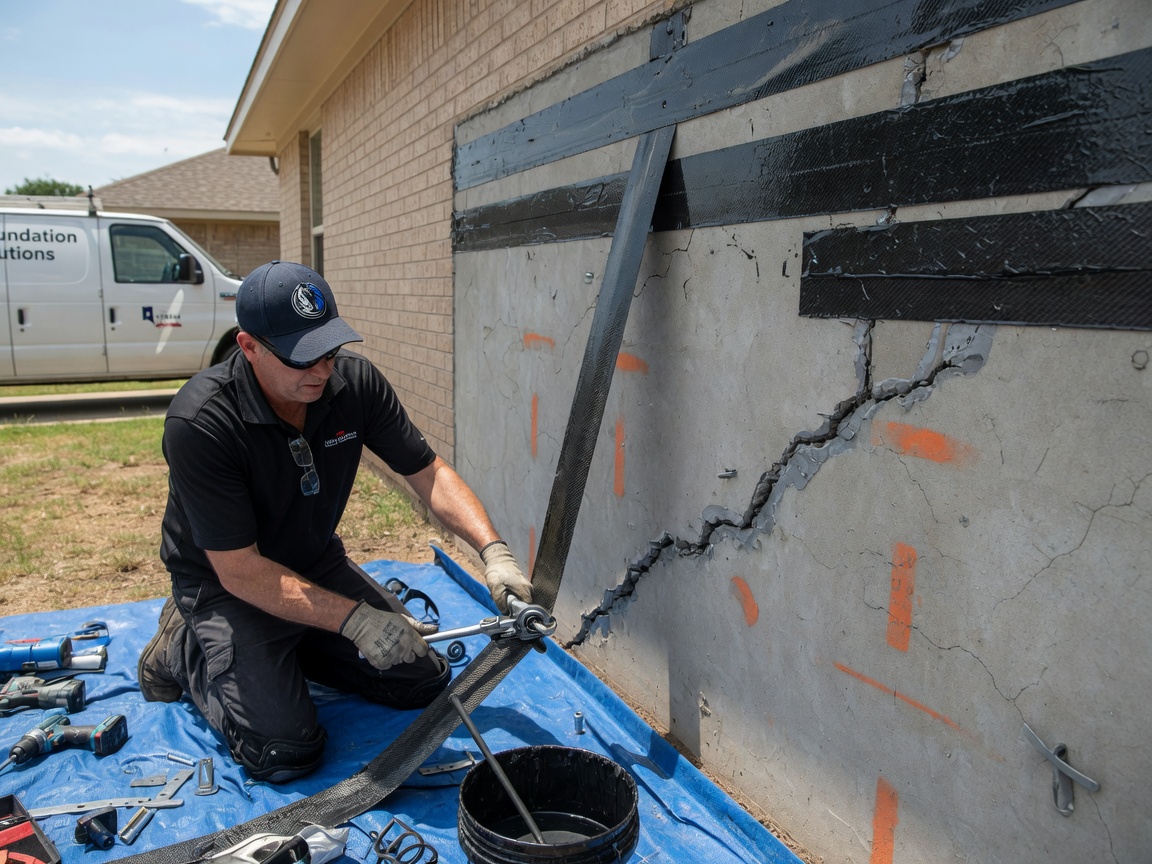
Carbon fiber straps bond directly to concrete with high-strength epoxy to counteract lateral soil pressure common in Dallas County. The material’s tensile strength exceeds steel while adding minimal thickness, making it suitable for finished basements in neighborhoods such as Oak Lawn and Uptown Dallas. Installers must first map crack patterns and measure wall deflection to determine strap spacing, typically 4 to 8 feet on center depending on severity.
In East Dallas and Lake Highlands, expansive clay soils expand during hot summers and contract in mild winters, repeatedly stressing older foundations. Carbon fiber straps arrest further movement without excavation when deflection remains under two inches. Installers avoid placement over utilities or in areas with active water intrusion until drainage is corrected first.
Local building practices require straps to meet engineered load calculations rather than prescriptive spacing alone. Homeowners in historic districts like Deep Ellum should confirm strap finish and concealment options with preservation guidelines before work begins. Proper surface preparation—grinding, cleaning, and drying—determines long-term bond integrity more than the strap itself.
When to Choose Carbon Fiber Straps Over Steel
Carbon fiber works best on walls with moderate bowing and limited access. Steel beams remain preferable when deflection exceeds four inches or when heavy surcharge loads exist from adjacent structures near Klyde Warren Park or Reunion Tower.
Carbon Fiber Straps Services We Offer
✓Vertical Crack Stabilization
Carbon fiber straps bridge and reinforce vertical foundation cracks to stop widening caused by seasonal soil movement in Dallas.
✓Horizontal Crack Reinforcement
Straps placed across horizontal cracks restore wall integrity where soil pressure has created step-like separation in Uptown and North Dallas homes.
✓Bowed Wall Correction
Multiple carbon fiber straps pull bowed basement walls back toward plumb without major excavation in Lake Highlands and East Dallas properties.
✓Stair-Step Crack Repair
Targeted carbon fiber placement halts stair-step cracking common in brick and block foundations throughout Bishop Arts District and Downtown Dallas.
✓Wall Deflection Monitoring Setup
Installers combine carbon fiber straps with measurement points to track ongoing movement in homes near the Dallas Arboretum and Dealey Plaza.
Carbon Fiber Straps Cost in Texas
| Service | Typical Range | What Affects It |
|---|---|---|
| Per linear foot of strap | $18–$45 | Varies with wall height and required epoxy volume |
| Full basement wall reinforcement | $2,800–$7,200 | Based on total straps needed and property access |
| Additional crack injection | $350–$900 | Added when active water leaks exist before strapping |
Ranges are typical for Texas and confirmed with an exact written quote before any work starts.
How it works
- 1
Site Assessment
Technicians examine interior and exterior walls, measure deflection, and note soil conditions around the Dallas property.
- 2
Surface Preparation
Grind, clean, and dry concrete to create a bond-ready surface free of coatings or efflorescence.
- 3
Strap Layout and Epoxy Application
Mark spacing, apply structural epoxy, and press carbon fiber straps into place while maintaining proper alignment.
- 4
Curing and Final Inspection
Allow epoxy to cure, then verify strap tension and wall stability before cleanup.
Pricing
Pricing depends on wall length, number of straps, and access conditions in Dallas homes.