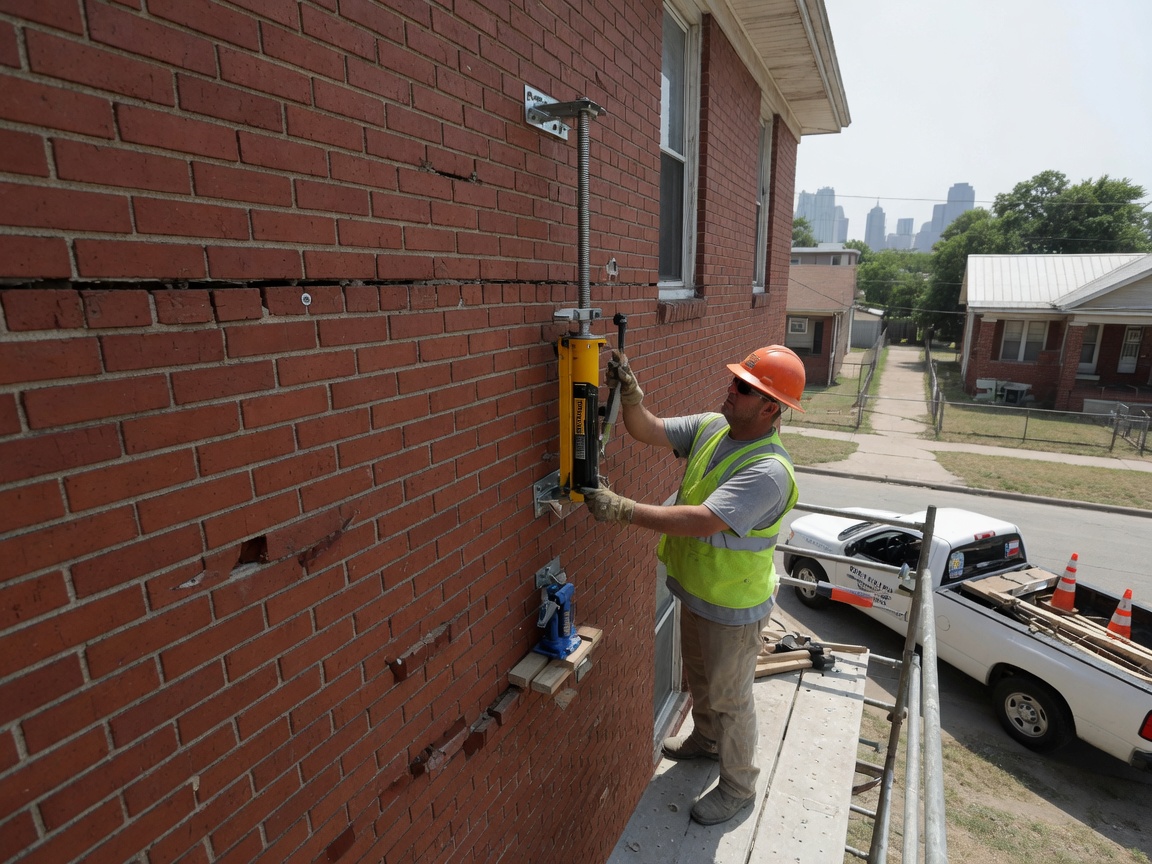
Dallas homes often see foundation walls bow inward when the region’s humid subtropical climate drives repeated wet-dry cycles in the clay soils. Heavy summer rains followed by milder winters cause the ground to expand and contract, pushing against basement and crawlspace walls in neighborhoods such as East Dallas and Lake Highlands. Wall straightening begins with a detailed assessment that identifies crack patterns, wall deflection, and soil pressure points before any hardware is installed.
Steel wall anchors, carbon-fiber straps, and helical tiebacks are the primary tools used here. Anchors are driven through the wall into stable soil outside the foundation, then tightened over time to pull the wall back toward plumb. Carbon-fiber reinforcement adds tensile strength without excavation when interior access is limited. In Uptown Dallas and Deep Ellum properties with tight lots, interior systems are often chosen to avoid disturbing sidewalks or neighboring structures.
Code compliance in Dallas County requires permits for structural wall work and proper drainage corrections to prevent future movement. We always verify that downspout extensions and grading meet city standards before finishing. Homeowners should expect the process to take several weeks of gradual tightening rather than a single-day fix, allowing the wall to move safely without new cracking.
Soil and Drainage Considerations
Dallas clay expands dramatically after heavy rains near Klyde Warren Park and the Dallas Arboretum. We routinely add exterior grading or French drains when wall straightening alone will not address the root moisture issue.
Wall Straightening Services We Offer
✓Wall Anchor Installation
Steel anchors are placed through bowing walls and secured in stable soil to gradually pull walls back into alignment in East Dallas and North Dallas homes.
✓Carbon Fiber Wall Reinforcement
High-strength carbon-fiber straps are bonded to interior walls to stop further movement without excavation, ideal for Uptown Dallas and Oak Lawn properties with limited exterior access.
✓Helical Tieback Systems
Helical tiebacks provide lateral support for severely deflected walls in Deep Ellum and Bishop Arts District buildings where soil conditions demand deeper anchoring.
✓Bowing Wall Assessment
Detailed on-site evaluation measures wall deflection and identifies soil pressure sources before recommending straightening methods for Downtown Dallas and Lake Highlands residences.
✓Combined Wall and Footer Repair
When wall movement has affected the footer, we stabilize both elements together to restore structural integrity in older East Dallas foundations.
Wall Straightening Cost in Texas
| Service | Typical Range | What Affects It |
|---|---|---|
| Wall Assessment | Free | Includes measurements and written recommendation |
| Wall Anchor System | $3,200–$6,500 | Per wall; varies with number of anchors and soil depth |
| Carbon Fiber Reinforcement | $1,800–$4,200 | Depends on wall height and number of straps |
| Helical Tieback Installation | $4,500–$8,000 | Higher range for deeper or multiple tiebacks |
| Drainage Add-On | $1,100–$2,800 | Grading or French drain to protect new work |
Ranges are typical for Texas and confirmed with an exact written quote before any work starts.
How it works
- 1
Initial Inspection
Measure wall deflection, document cracks, and test soil conditions around the property in Dallas neighborhoods.
- 2
System Design
Select anchors, carbon fiber, or tiebacks based on lot access, wall height, and severity of movement.
- 3
Installation
Place hardware and begin gradual tightening over multiple visits to safely return the wall to plumb.
- 4
Drainage Correction
Adjust grading and downspouts to reduce future soil pressure on the straightened wall.
- 5
Final Walkthrough
Confirm alignment, review maintenance steps, and provide written documentation of work performed.
Pricing
Cost depends on wall length, degree of bow, and chosen system. Free assessments available during business hours.