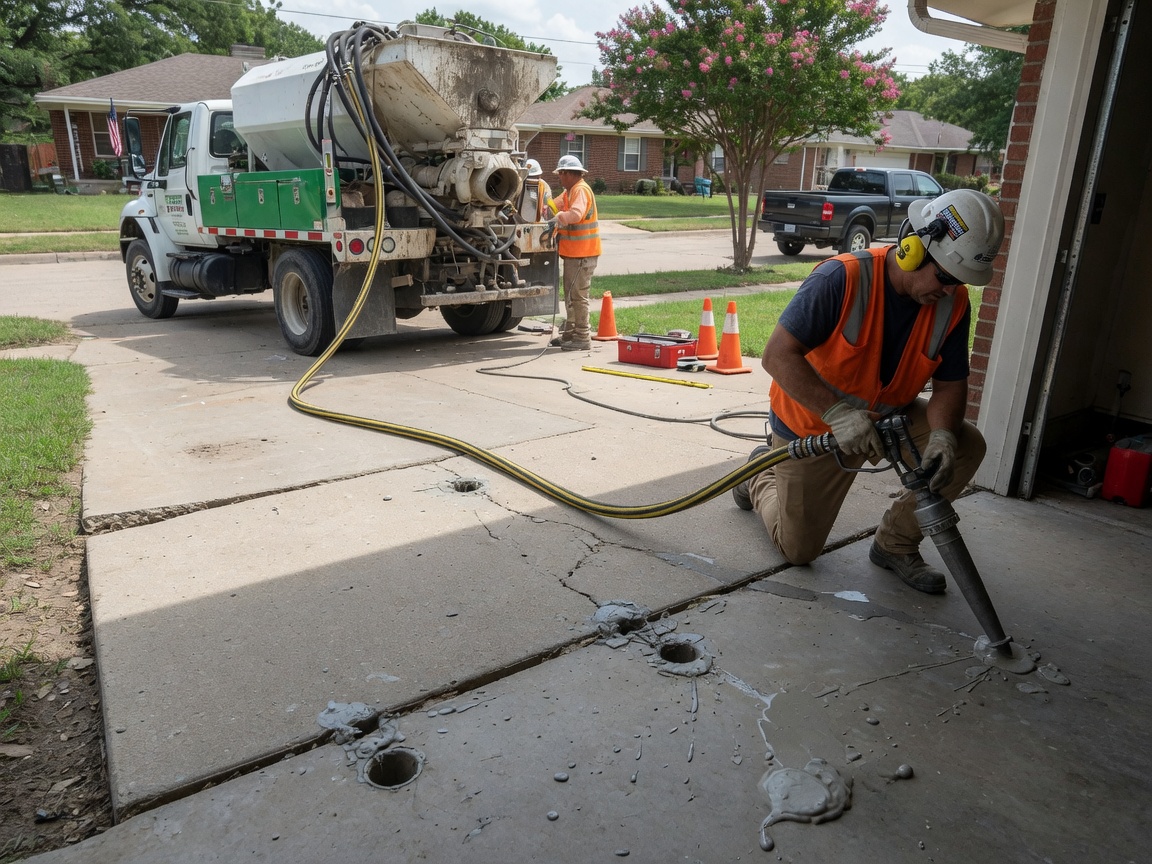
Dallas clay soils expand and contract with the humid subtropical climate, where hot summers pull moisture from the ground and even mild winters allow continued settlement around older slabs. Mudjacking uses a cement-based slurry pumped through small holes to lift and stabilize concrete without full replacement. Technicians must watch for hidden voids under driveways near the Dallas Arboretum or patios in Bishop Arts District, where tree roots and poor drainage accelerate movement. Skipping a full inspection can leave underlying plumbing leaks or foundation cracks unaddressed, turning a simple lift into a repeat call.
Foam injection offers a lighter alternative when weight matters, such as on second-story balconies or near utility lines in Deep Ellum. Crews drill 1-inch holes on a grid pattern, inject material in controlled stages, and monitor lift with laser levels to avoid over-raising adjacent sections. Local building practices in North Dallas often require permits for work near property lines, and crews document elevations before and after to satisfy inspectors. Hot weather can cause the slurry to set faster, so crews adjust mix ratios on site to maintain flow and bond strength.
Soil and Climate Considerations
Dallas summers dry expansive clays while occasional heavy rains create washouts under slabs in Uptown Dallas and Oak Lawn. Mudjacking succeeds only when soil remains stable enough to support the lifted concrete; active erosion or ongoing foundation movement requires separate stabilization first. Crews always check for active leaks before injecting material.
When Mudjacking Is Not Recommended
Slabs with cracks wider than 1/4 inch, multiple step fractures, or evidence of structural wall movement need foundation repair evaluation first. In Lake Highlands and East Dallas homes built before modern drainage codes, mudjacking alone may mask deeper issues that surface after the next wet season.
Mudjacking / Slabjacking Services We Offer
✓Driveway Slab Leveling
Lifts and stabilizes settled driveway sections common in North Dallas homes where tree roots and seasonal moisture shifts create voids.
✓Patio and Pool Deck Mudjacking
Restores level surfaces around pools and patios in Uptown Dallas and Oak Lawn without disturbing landscaping or tile finishes.
✓Garage Floor Slabjacking
Corrects sunken garage slabs that trap water near doors, using controlled injection to avoid damaging overhead structures.
✓Sidewalk and Walkway Repair
Levels public and private walkways in Deep Ellum and Bishop Arts District to reduce trip hazards and meet city accessibility standards.
✓Commercial Loading Dock Leveling
Raises settled dock slabs in East Dallas industrial areas to restore proper drainage and vehicle clearance.
Mudjacking / Slabjacking Cost in Texas
| Service | Typical Range | What Affects It |
|---|---|---|
| Small patio or walkway section | $600–$1,200 | Price rises with multiple voids or limited equipment access. |
| Standard residential driveway | $1,400–$2,800 | Varies by total square footage and required lift height. |
| Garage floor slab | $1,800–$3,500 | Higher when interior access restricts equipment. |
| Commercial dock or large slab | $3,000–$6,500 | Depends on thickness, reinforcement, and traffic constraints. |
Ranges are typical for Texas and confirmed with an exact written quote before any work starts.
How it works
- 1
Site Assessment
Technicians measure elevations, identify voids, and check for active leaks or structural concerns across the slab.
- 2
Hole Placement and Drilling
Small holes are drilled in a calculated grid pattern to reach all low areas while minimizing visible patching.
- 3
Material Injection
Slurry or foam is pumped in stages, with constant monitoring to achieve uniform lift without cracking the concrete.
- 4
Finishing and Cleanup
Holes are filled with color-matched material, excess is removed, and the site is left ready for immediate use.
Pricing
Costs depend on slab size, lift amount, and access. Texas Foundation Repair Pros is open Mon–Fri 8am–6pm, Sat 9am–2pm for on-site quotes.