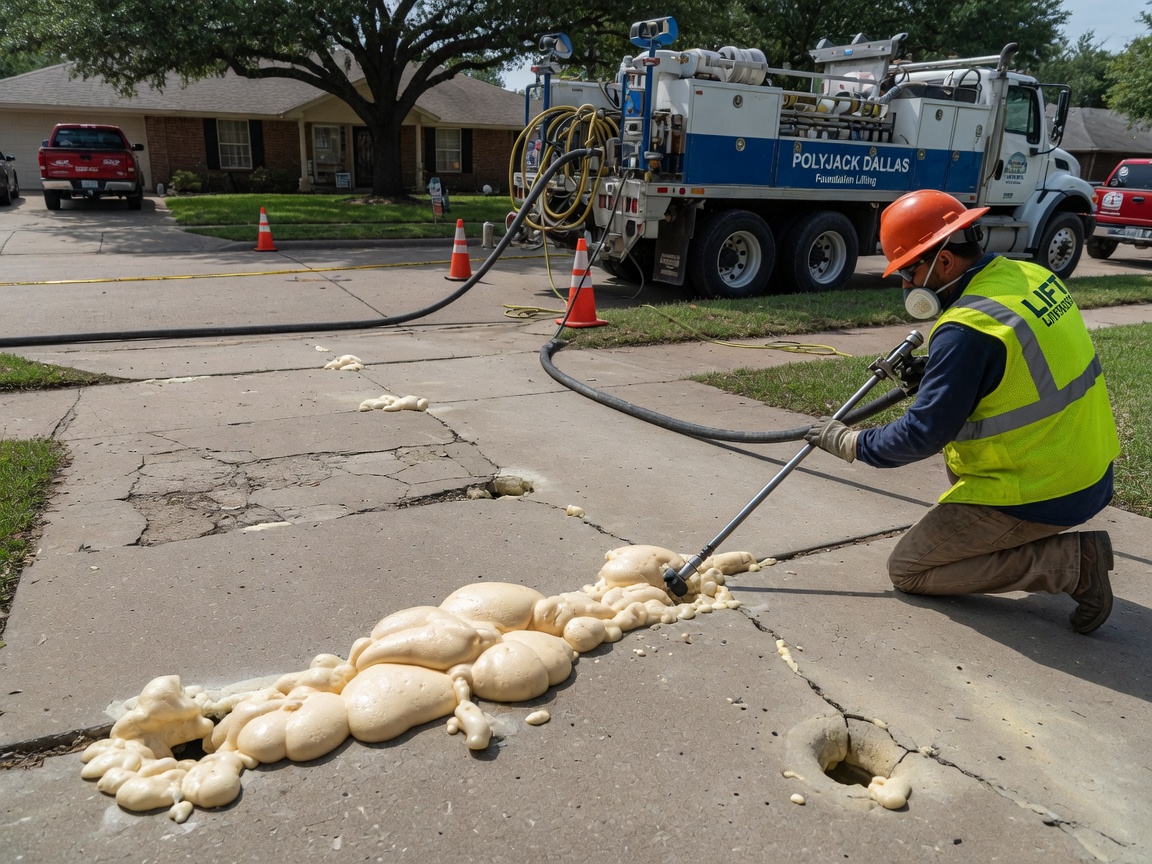
Dallas clay soils expand and contract sharply with the area's humid subtropical climate, where hot summers pull moisture from the ground and mild winters allow rapid re-saturation. Polyjacking counters this movement by injecting two-part polyurethane foam through small holes drilled in the slab. The foam expands to fill voids and raises the concrete to within a quarter-inch of level. Because the material cures in minutes, crews can often complete a typical residential job and return the surface to use the same day.
Crew experience matters when working near underground utilities or in tight access areas such as Deep Ellum alleys and Bishop Arts District backyards. Proper hole placement avoids rebar and post-tension cables common in newer North Dallas construction. Foam density is selected based on soil load tests performed on site; lighter residential slabs use 2-3 lb foam while commercial pads may require 4-6 lb material. Over-injection can create new cracks, so operators monitor lift with laser levels throughout the process.
Dallas building codes require permits for structural repairs in many neighborhoods, including Lake Highlands and Downtown Dallas. Crews document pre-existing elevations and provide the homeowner a written report before starting work. In older homes near Dealey Plaza or the Dallas Arboretum, crews also check for deteriorated plumbing lines that can re-wet the soil and undo the lift. Homeowners should expect a 24-hour cure before placing heavy furniture or vehicles back on the repaired area.
Polyjacking works best on slabs that have dropped less than three inches. Larger movements usually need a combination of piers and foam to address deeper soil issues. After injection, the small drill holes are filled with non-shrink grout matched to the existing concrete color. This leaves a surface that can be covered with tile or carpet without telegraphing repair locations.
Polyjacking (Polyurethane Foam Injection) Services We Offer
✓Residential Slab Polyjacking
Lifts interior and exterior concrete slabs on single-family homes in Oak Lawn and Lake Highlands using density-matched polyurethane foam.
✓Commercial Warehouse Floor Leveling
Stabilizes settled warehouse and retail slabs in North Dallas industrial parks with high-density foam rated for forklift traffic.
✓Void Filling Under Driveways
Fills erosion voids beneath concrete driveways near Klyde Warren Park and Uptown Dallas without removing the existing surface.
✓Pool Deck Stabilization
Raises and supports settled pool decks around East Dallas and Bishop Arts District homes to eliminate trip hazards and water pooling.
✓Historic Building Slab Repair
Low-impact foam injection for pre-1950 structures in Deep Ellum and Downtown Dallas where excavation would disturb original foundations.
Polyjacking (Polyurethane Foam Injection) Cost in Texas
| Service | Typical Range | What Affects It |
|---|---|---|
| Typical residential garage slab | $1,800–$3,200 | Price rises with void depth and number of interior walls |
| Driveway section (two panels) | $900–$1,600 | Affected by proximity to city sidewalks and irrigation lines |
| Pool deck stabilization | $2,400–$4,100 | Higher when foam must be placed under coping stones |
| Small commercial entry slab | $3,500–$6,000 | Includes traffic-rated foam and permit coordination |
Ranges are typical for Texas and confirmed with an exact written quote before any work starts.
How it works
- 1
Site Assessment
Technicians map slab elevations and locate utilities using ground-penetrating radar before any drilling begins.
- 2
Strategic Drilling
Small 5/8-inch holes are drilled at engineered spacing to reach voids without damaging rebar or post-tension cables.
- 3
Foam Injection
Polyurethane is injected under controlled pressure while laser levels track lift in real time.
- 4
Finishing and Cleanup
Holes are grouted, debris is removed, and a final elevation report is provided to the homeowner.
Pricing
Cost depends on slab size, void volume, and access; Mon–Fri 8am–6pm, Sat 9am–2pm for scheduling.